Wednesday, May 13, 2009

Mesothelioma Symptoms

Symptoms of mesothelioma may not appear until 20 to 50 years after exposure to asbestos. Shortness of breath, cough, and pain in the chest due to an accumulation of fluid in the pleural space are often symptoms of pleural mesothelioma.

Symptoms of peritoneal mesothelioma include weight loss and cachexia, abdominal swelling and pain due to ascites (a buildup of fluid in the abdominal cavity). Other symptoms of peritoneal mesothelioma may include bowel obstruction, blood clotting abnormalities, anemia, and fever. If the cancer has spread beyond the mesothelium to other parts of the body, symptoms may include pain, trouble swallowing, or swelling of the neck or face.

These symptoms may be caused by mesothelioma or by other, less serious conditions.

Mesothelioma that affects the pleura can cause these signs and symptoms:

  • chest wall pain
  • pleural effusion, or fluid surrounding the lung
  • shortness of breath
  • fatigue or anemia
  • wheezing, hoarseness, or cough
  • blood in the sputum (fluid) coughed up (hemoptysis)

In severe cases, the person may have many tumor masses. The individual may develop a pneumothorax, or collapse of the lung. The disease may metastasize, or spread, to other parts of the body.

Tumors that affect the abdominal cavity often do not cause symptoms until they are at a late stage. Symptoms include:

  • abdominal pain
  • ascites, or an abnormal buildup of fluid in the abdomen
  • a mass in the abdomen
  • problems with bowel function
  • weight loss

In severe cases of the disease, the following signs and symptoms may be present:

  • blood clots in the veins, which may cause thrombophlebitis
  • disseminated intravascular coagulation, a disorder causing severe bleeding in many body organs
  • jaundice, or yellowing of the eyes and skin
  • low blood sugar level
  • pleural effusion
  • pulmonary emboli, or blood clots in the arteries of the lungs
  • severe ascites

A mesothelioma does not usually spread to the bone, brain, or adrenal glands. Pleural tumors are usually found only on one side of the lungs.

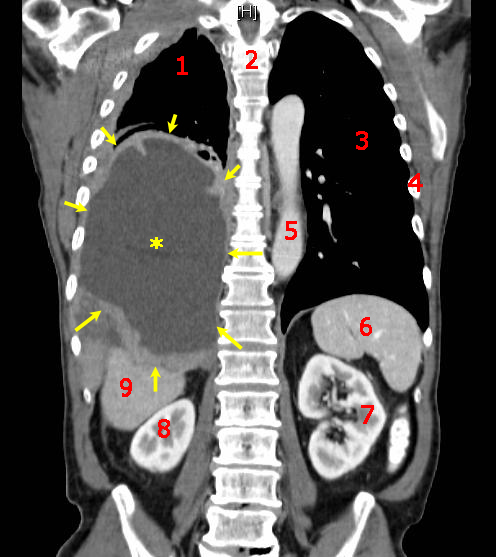
Mesothelioma


Mesothelioma is a form of cancer that is almost always caused by exposure to asbestos. In this disease, malignant cells develop in the mesothelium, a protective lining that covers most of the body's internal organs. Its most common site is the pleura (outer lining of the lungs and internal chest wall), but it may also occur in the peritoneum (the lining of the abdominal cavity), the heart,the pericardium (a sac that surrounds the heart) or tunica vaginalis.

Most people who develop mesothelioma have worked on jobs where they inhaled asbestos particles, or they have been exposed to asbestos dust and fiber in other ways. Washing the clothes of a family member who worked with asbestos can also put a person at risk for developing mesothelioma.Unlike lung cancer, there is no association between mesothelioma and smoking, but smoking greatly increases risk of other asbestos induced cancer.Compensation via asbestos funds or lawsuits is an important issue in mesothelioma (see asbestos and the law).

The symptoms of mesothelioma include shortness of breath due to pleural effusion (fluid between the lung and the chest wall) or chest wall pain, and general symptoms such as weight loss. The diagnosis may be suspected with chest X-ray and CT scan, and is confirmed with a biopsy (tissue sample) and microscopic examination. A thoracoscopy (inserting a tube with a camera into the chest) can be used to take biopsies. It allows the introduction of substances such as talc to obliterate the pleural space (called pleurodesis), which prevents more fluid from accumulating and pressing on the lung. Despite treatment with chemotherapy, radiation therapy or sometimes surgery, the disease carries a poor prognosis. Research about screening tests for the early detection of mesothelioma is ongoing.

Wednesday, April 8, 2009

Breast Cancer Treatments

The mainstay of breast cancer treatment is surgery when the tumor is localized, with possible adjuvant hormonal therapy (with tamoxifen or an aromatase inhibitor), chemotherapy, and/or radiotherapy. At present, the treatment recommendations after surgery (adjuvant therapy) follow a pattern. This pattern is subject to change, as every two years, a worldwide conference takes place in St. Gallen, Switzerland, to discuss the actual results of worldwide multi-center studies. Depending on clinical criteria (age, type of cancer, size, metastasis) patients are roughly divided to high risk and low risk cases, with each risk category following different rules for therapy. Treatment possibilities include radiation therapy, chemotherapy, hormone therapy, and immune therapy.

In planning treatment, doctors can also use PCR tests like Oncotype DX or microarray tests like MammaPrint that predict breast cancer recurrence risk based on gene expression. In February 2007, the MammaPrint test became the first breast cancer predictor to win formal approval from the Food and Drug Administration. This is a new gene test to help predict whether women with early-stage breast cancer will relapse in 5 or 10 years, this could help influence how aggressively the initial tumor is treated.

Interstitial laser thermotherapy (ILT) is an innovative method of treating breast cancer in a minimally invasive manner and without the need for surgical removal, and with the absence of any adverse effect on the health and survival of the patient during intermediate followup.

Radiation treatment is also used to help destroy cancer cells that may linger after surgery. Radiation can reduce the risk of recurrence by 50-66% (1/2 - 2/3rds reduction of risk) when delivered in the correct dose.

Breast Cancer

Breast cancer is a cancer that starts in the cells of the breast in women and men. Worldwide, breast cancer is the second most common type of cancer after lung cancer (10.4% of all cancer incidence, both sexes counted)and the fifth most common cause of cancer death.In 2004, breast cancer caused 519,000 deaths worldwide (7% of cancer deaths; almost 1% of all deaths).
Breast cancer is about 100 times as frequent among women as among men, but survival rates are equal in both sexes.


Signs and symptoms


The first symptom, or subjective sign, of breast cancer is typically a lump that feels different from the surrounding breast tissue. According to the The Merck Manual, more than 80% of breast cancer cases are discovered when the woman feels a lump. According to the American Cancer Society, the first medical sign, or objective indication of breast cancer as detected by a physician, is discovered by mammogram.Lumps found in lymph nodes located in the armpits and/or collarbone[citation needed] can also indicate breast cancer.

Indications of breast cancer other than a lump may include changes in breast size or shape, skin dimpling, nipple inversion, or spontaneous single-nipple discharge. Pain is an unreliable tool in determining the presence or absence of breast cancer, but may be indicative of other breast health issues such as mastodynia.

When breast cancer cells invade the dermal lymphatics—small lymph vessels in the skin of the breast—its presentation can resemble skin inflammation and thus is known as inflammatory breast cancer (IBC). Symptoms of inflammatory breast cancer include pain, swelling, warmth and redness throughout the breast, as well as an orange-peel texture to the skin referred to as peau d'orange.

Another reported symptom complex of breast cancer is Paget's disease of the breast. This syndrome presents as eczematoid skin changes such as redness and mild flaking of the nipple skin. As Paget's advances, symptoms may include tingling, itching, increased sensitivity, burning, and pain. There may also be discharge from the nipple. Approximately half of women diagnosed with Paget's also have a lump in the breast.

Occasionally, breast cancer presents as metastatic disease, that is, cancer that has spread beyond the original organ. Metastatic breast cancer will cause symptoms that depend on the location of metastasis. Common sites of metastasis include bone, liver, lung and brain. Unexplained weight loss can occasionally herald an occult breast cancer, as can symptoms of fevers or chills. Bone or joint pains can sometimes be manifestations of metastatic breast cancer, as can jaundice or neurological symptoms. These symptoms are "non-specific", meaning they can also be manifestations of many other illnesses.

Most symptoms of breast disorder do not turn out to represent underlying breast cancer. Benign breast diseases such as mastitis and fibroadenoma of the breast are more common causes of breast disorder symptoms. The appearance of a new symptom should be taken seriously by both patients and their doctors, because of the possibility of an underlying breast cancer at almost any age.

What is a Cancer


Cancer (medical term: malignant neoplasm) is a class of diseases in which a group of cells display uncontrolled growth (division beyond the normal limits), invasion (intrusion on and destruction of adjacent tissues), and sometimes metastasis (spread to other locations in the body via lymph or blood). These three malignant properties of cancers differentiate them from benign tumors, which are self-limited, do not invade or metastasize. Most cancers form a tumor but some, like leukemia, do not. The branch of medicine concerned with the study, diagnosis, treatment, and prevention of cancer is oncology.

Cancer may affect people at all ages, even fetuses, but the risk for most varieties increases with age.Cancer causes about 13% of all deaths. According to the American Cancer Society, 7.6 million people died from cancer in the world during 2007. Cancers can affect all animals.

Nearly all cancers are caused by abnormalities in the genetic material of the transformed cells[citation needed]. These abnormalities may be due to the effects of carcinogens, such as tobacco smoke, radiation, chemicals, or infectious agents. Other cancer-promoting genetic abnormalities may be randomly acquired through errors in DNA replication, or are inherited, and thus present in all cells from birth. The heritability of cancers are usually affected by complex interactions between carcinogens and the host's genome. New aspects of the genetics of cancer pathogenesis, such as DNA methylation, and microRNAs are increasingly recognized as important.